1. Talk to a specialist
30-60 minutes
You’ll speak with a reverse mortgage specialist who can answer every question and give you a clear picture of what’s possible—completely free, with no obligation to apply.




A Home Equity Conversion Mortgage (HECM) allows you to convert a portion of your home equity into tax-free funds1, without a new monthly mortgage payment.2
 Excellent 4.7 out of 5 stars3
2The borrower must meet all loan obligations, including living in the property as the principal residence and paying property charges, including property taxes, fees, hazard insurance. The borrower must maintain the home. If the homeowner does not meet these loan obligations, then the loan will need to be repaid.
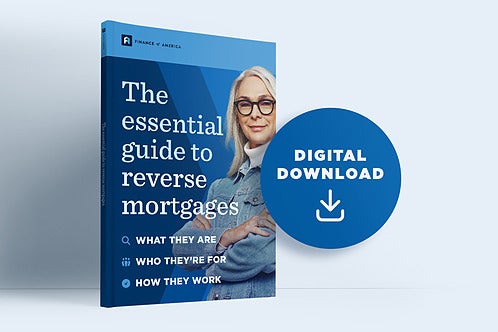
Get a quick overview below, or dive into our reverse mortgage guide for the full picture.
2The borrower must meet all loan obligations, including living in the property as the principal residence and paying property charges, including property taxes, fees, hazard insurance. The borrower must maintain the home. If the homeowner does not meet these loan obligations, then the loan will need to be repaid.
4The right to remain in the home is contingent on paying property taxes and homeowner’s insurance, maintaining the home, and complying with the loan terms.
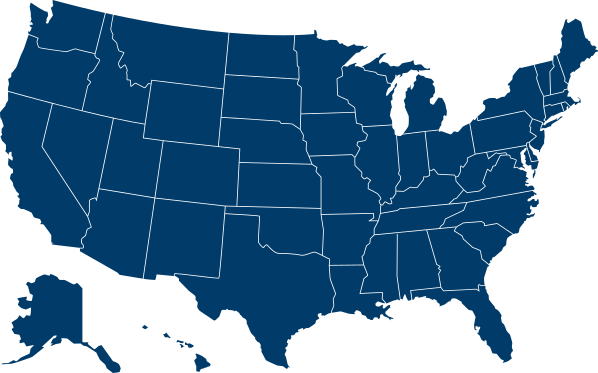
HECM reverse mortgages are available nationwide.
30-60 minutes
You’ll speak with a reverse mortgage specialist who can answer every question and give you a clear picture of what’s possible—completely free, with no obligation to apply.
1-2 hours
Meet with an independent, HUD-approved counselor who will explain the HECM loan, answer your questions, and help you understand your options before moving forward.
15 minutes
A loan officer walks you through each part of the paperwork. You’ll always know where things stand and what’s coming next.
1-3 weeks
An appraiser visits your home to confirm its market value, which is used to finalize your loan amount. During the underwriting review, your processor will provide regular updates so you’re never left wondering what’s next.
2-3 days
If approved, you’ll receive confirmation that your loan is approved and ready to close. Your loan officer will walk you through the final numbers and make sure all your questions are answered before signing.
1 hour + 3 days
After signing, there’s a 3-business-day waiting period. During this time, you can cancel for any reason. Once that period ends, your funds are delivered based on how you chose to receive them. You can cancel within that time, no questions asked.
A HECM is an FHA-insured loan for homeowners age 62 and older that lets you convert a portion of your home equity into tax-free funds. You can receive the money as a lump sum, monthly payments, a line of credit, or a combination of these options. Unlike a traditional mortgage, no monthly mortgage payments are required.*
Another key advantage is that any existing mortgage is paid off using the new loan proceeds, which can free up monthly cash flow for other expenses, goals, or opportunities as they arise. Learn More
*The borrower must meet all loan obligations, including living in the property as the principal residence, maintaining the home, and paying property charges, including property taxes, fees, hazard insurance. If the homeowner does not meet these loan obligations, then the loan will need to be repaid.
While a reverse mortgage doesn’t require monthly mortgage payments*, there is an important tradeoff to understand. Like any loan, a reverse mortgage charges interest. If you choose not to make payments, the interest is added to the loan balance over time, which means the amount owed can grow.
The good news is that you can pay as much or as little as you’d like—including nothing at all. Any payments you make can help reduce the amount of interest that accrues, slow the growth of the loan balance, and preserve more of your home equity.
*The borrower must meet all loan obligations, including living in the property as the principal residence, maintaining the home, and paying property charges, including property taxes, fees, hazard insurance. If the homeowner does not meet these loan obligations, then the loan will need to be repaid.
HECM reverse mortgages include built-in borrower safeguards required by the Federal Housing Administration (FHA). Before closing, you’ll complete independent HUD-approved counseling to help you understand the loan and determine whether it’s right for you. You’ll also benefit from non-recourse protection, which means you or your heirs won’t owe more than your home’s value when the loan becomes due and is repaid. As long as you meet your loan obligations, you maintain ownership of your home and can continue to live there.*
*The right to remain in the home is contingent on paying property taxes and homeowner’s insurance, maintaining the home, and complying with the loan terms.
*The borrower must meet all loan obligations, including living in the property as the principal residence, maintaining the home, and paying property charges, including property taxes, fees, hazard insurance. If the homeowner does not meet these loan obligations, then the loan will need to be repaid.
HECMs are FHA-insured for homeowners 62+ with a government lending limit and mortgage insurance requirement. HomeSafe is FOA’s proprietary jumbo reverse mortgage for homeowners 55+* who want to borrow up to $4 million without mortgage insurance or origination fees.
*For certain HomeSafe products only, excluding Massachusetts, New York, and Washington, where the minimum age is 60, and North Carolina and Texas where the minimum age is 62.
1This is not tax advice; borrowers should consult a tax professional.
2The borrower must meet all loan obligations, including living in the property as the principal residence and paying property charges, including property taxes, fees, hazard insurance. The borrower must maintain the home. If the homeowner does not meet these loan obligations, then the loan will need to be repaid.
3As of July 2026. Rating based on verified reviews from Trustpilot.com
4The right to remain in the home is contingent on paying property taxes and homeowner’s insurance, maintaining the home, and complying with the loan terms.